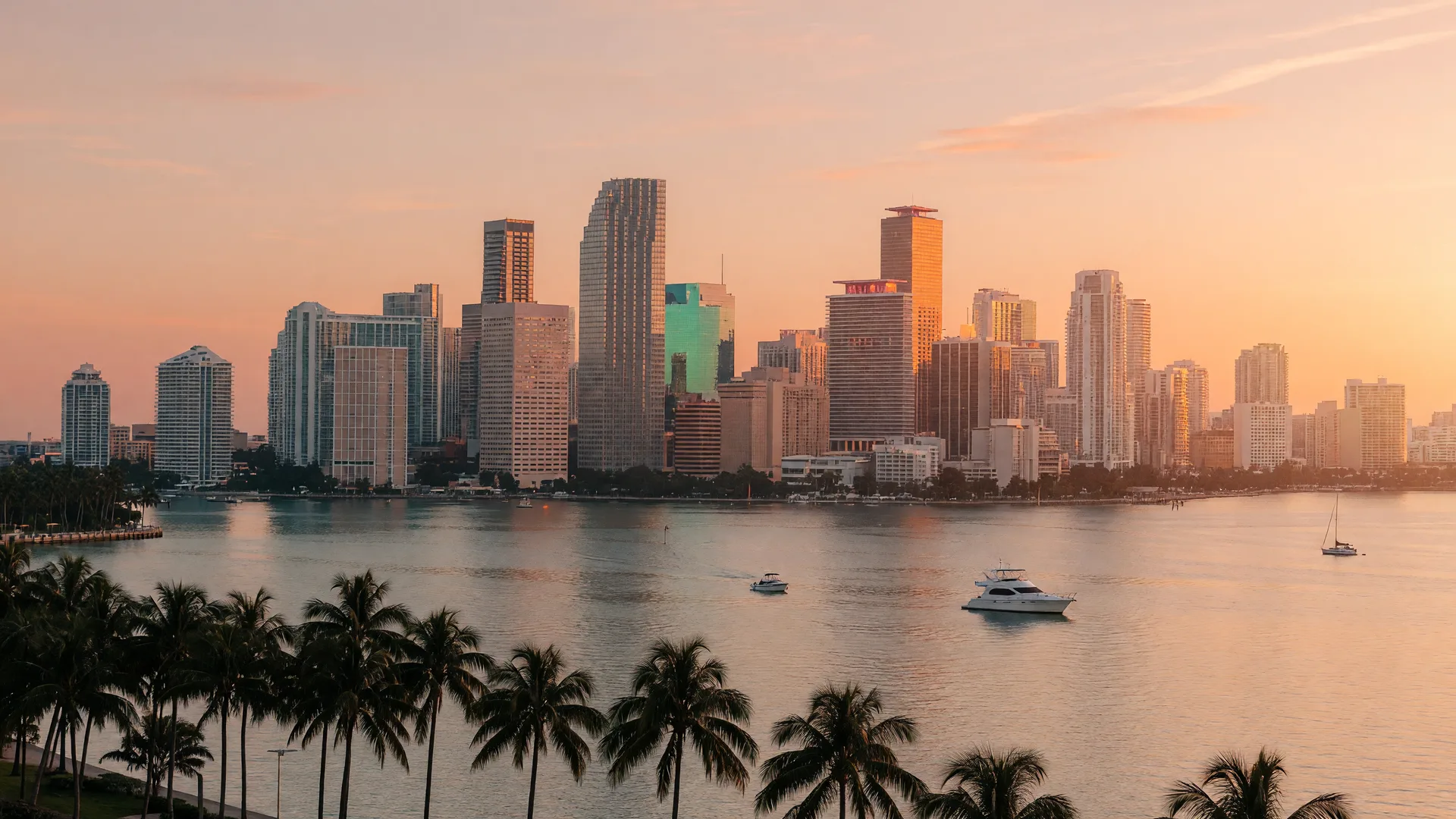
Relocating to Miami, Florida · A guide by Ruth Rivera
Living in Miami.
The honest, sourced guide.
After more than 30 years in Florida real estate, I have watched Miami become a city
that surprises newcomers. Here is my honest answer in one line: Miami is the
international gateway city where the beach lifestyle, the business hub of Latin
America, and a collection of fiercely distinct neighborhoods all meet inside a single
subtropical county.
This guide is built for relocators. I walk you through the current Miami-Dade housing
market with dated, sourced numbers, what to know about schools, the neighborhoods
people actually choose, real commute times on the main corridors, and an honest read
on the cost of living. Nothing here is invented or guesswork: where public sources
disagree, I show the range and say so. And when you are ready to look at homes, I
would love to help you find the right one.
These are the numbers that matter when you compare Miami to where you live now. Every
figure comes from the named public source, with its date, verified together on October 1,
2026.
Measure
Miami-Dade figure
Source and date
Median home price (single-family)
$680,000
MIAMI Association of Realtors (MIAMI REALTORS), August 2026; condo median $410,000
Price per square foot
≈ $387 (median)
Redfin Miami-Dade County tracker, August 2026 (+2.7% year over year). MIAMI REALTORS
publishes no single official county median
Median days on market
52 days (single-family) · 85 (condos)
MIAMI Association of Realtors, June 2026 (time to contract)
Median rent (all apartments)
≈ $1,791 (county)
Apartment List county rent data, April 2026; City of Miami median $1,908 (Apartment
List, July 2026)
Year-over-year price change
+3.8%
MIAMI Association of Realtors, August 2026 vs. August 2025 (single-family median;
condos +2.2%)
MIAMI Association of Realtors, June 2026 (active listings down 14.9% year over year)
Source notes: MIAMI Association of Realtors (MIAMI REALTORS) market statistics, August 2026
and June 2026 releases, via miamirealtors.com and its press coverage; Redfin Miami-Dade
County housing market tracker, August 2026 (Redfin blends all property types and reports a
$556,000 overall three-month median); Apartment List county and city rent reports, April and
July 2026. Asking-rent trackers using different methods run higher, for example Yardi Matrix
near $2,660 and Zillow's metro figure near $2,665 in 2026, so the rental row shows the
county median rather than an invented number. All figures verified together on October 1,
2026.
What this means for buyers: single-family
prices are steady with real negotiating room on condos, where supply is deep. Sales have
risen for eleven straight months, so well-priced homes still move, and the growing condo
inventory gives value-focused buyers unusual choices, especially in the east-side towers.
Schools
Schools: what buyers need to know.
The school system serving Miami is huge, and that is a feature once you understand it.
Miami-Dade County Public Schools (M-DCPS) reported about 530 schools in the 2025-26
school year (NCES district directory) with roughly 313,000 to 333,000 students depending
on the count and the date: first-day enrollment for 2025-26 was 313,220, down from
326,279 the year before (Miami Herald), while the NCES district count lists about
333,233. By size it is one of the largest districts in the nation, typically ranked
third, behind only New York City and Los Angeles Unified, and in some recent tallies it
trades places with Chicago (NCES; Miami Herald).
Buyers who prefer a county-run system with a different feel sometimes look just north at
Broward County Public Schools, which serves Fort Lauderdale and the communities up to
the county line: about 236,548 students and 322 schools in the 2025-26 school year
(district enrollment counts). For commuters, that usually means a longer drive across
the county line, so it is a trade most families weigh carefully.
My honest rule, which I repeat on every tour: school assignments are address-specific,
and they can change as districts redraw boundaries or schools fill up. Two homes a few
streets apart can feed different schools, and a great school at one address does not
guarantee the same school next door. Florida also gives families school choice options,
so your zoned school is not always your only option.
Verify by address, every time
Before you make an offer, confirm the exact address with the district directly:
Miami-Dade County Public Schools at dadeschools.net, or Broward County Public Schools
at browardschools.com for addresses just north of the county line. I keep this page to
district facts on purpose. Rankings and opinions about schools belong in a
conversation about your child and your family, not a guide for everyone, and I am
happy to have that conversation with you.
Neighborhoods
Eight communities people choose.
There is no single best neighborhood in Miami, because the right fit depends on your
commute, your budget, and the way you want to live. What I can do is describe each area by
its character, who it tends to suit, and what the drive feels like. I describe areas by
lifestyle on purpose: under the Fair Housing Act, every buyer has the right to live in any
of these communities, and I serve everyone with the same care, in English or Spanish.
Brickell
The financial district on Biscayne Bay: a skyline of high-rise condos and bank towers built around a genuinely walkable core. Rooftop pools, bayfront promenades, and a young, international energy define daily life here.
Good for: Young professionals and city lovers who want to live where they work.
The heart of the action: most residents walk to work in Brickell or ride the free Metromover or Metrorail the few minutes into downtown Miami. The beach is usually about 20 to 30 minutes by car, traffic depending.
Coconut Grove
Miami's oldest neighborhood, a bayfront village with shaded streets, the leafy green of Kennedy Park, and a relaxed, creative soul that has outlasted every boom. Homes mix historic cottages, newer townhomes, and bayfront estates.
Good for: Families, creatives, and professionals who want trees and water with the city close.
Downtown and Brickell are typically about 15 to 25 minutes via U.S. 1 or I-95, and the airport about 20 to 30 off-peak.
Coral Gables
The City Beautiful: Mediterranean Revival architecture, tree-lined boulevards, and a walkable retail heart along Miracle Mile and the Gables' historic downtown. It is one of the most storied, owner-occupied communities in Florida.
Good for: Families and executives drawn to classic character, quiet streets, and a real downtown.
About 15 to 25 minutes to downtown and Brickell, and roughly 20 to 30 to the airport depending on the hour.
Wynwood
The art district: former warehouses now covered in world-famous murals, galleries, breweries, and a dining scene that draws visitors from everywhere. Loft and condo living sits beside a block-by-block arts economy.
Good for: Creatives and young professionals who want energy and walkability.
Downtown and Brickell are about 10 to 20 minutes; the Design District and Midtown are at your doorstep.
Kendall
The classic family suburb of southwest Dade: tree-shaded subdivisions, The Falls shopping village, and a deep inventory of single-family homes. It feels a world away from downtown while remaining inside the county.
Good for: Families who want suburban space, yards, and established communities.
Downtown and Brickell typically run about 30 to 40 minutes in rush hour via the Turnpike or U.S. 1; the Palmetto and Turnpike give you express options.
Doral
A master-planned, fast-growing city anchored by business parks, golf, and an international workforce, minutes from Miami International Airport and the 836/826 junction. Newer homes and a family-friendly, amenity-driven built environment.
Good for: Airport and industrial-corridor workers, plus families who want new construction and planned amenities.
The airport is often 10 to 15 minutes, and downtown and Brickell about 25 to 40 depending on the hour.
Miami Beach
The beach towns: Art Deco South Beach, quiet residential North Beach, and everywhere the ocean at the end of the street. Life slows to island pace even though the city is just across the bay.
Good for: Beach-lifestyle lovers, second-home buyers, retirees, and anyone who wants water views daily.
Downtown is typically about 20 to 30 minutes via the Julia Tuttle Causeway (I-195) or the MacArthur Causeway, with weekend traffic your main variable.
Aventura
A planned, largely self-contained city at the county line: waterfront condos, Aventura Mall, golf, and broad boulevards, minutes from Broward and the Turnpike. It is Florida's address for many who want amenities without the island commute.
Good for: Families, retirees, and condo buyers who want resort-style living with easy access to both Dade and Broward.
Downtown and Brickell run about 25 to 35 minutes, Fort Lauderdale about 20 to 30, and the airport about 20 to 30 with traffic.
A note on fit: these are everyday starting
points, not a complete list. Miami has dozens of communities worth a look, from Edgewater
and the Design District to suburban cities like Homestead, and the right one for you may be
a quieter street I only find by listening to what you actually need.
Commute & connectivity
Getting around: the honest picture.
The official average one-way commute is about 31 minutes across Miami-Dade County (U.S.
Census, American Community Survey 2024), and greater Miami ranks among the most
congested metros in the country: second in the U.S. in TomTom's 2025 index and sixth in
INRIX's 2024 global scorecard, with about 74 hours lost to congestion per driver per year.
Your real number depends on which corridor you live near and which one you drive, so here
is the practical map.
Downtown Miami
The government and corporate core on the bay's edge: county and federal offices, banks, Brightline's MiamiCentral station, and the hub of Metrorail and the free Metromover. Living in Brickell, the Arts & Entertainment District, or Edgewater keeps this commute in minutes, and much of it is walkable.
Brickell financial district
Finance, fintech, banking, and international business cluster in the towers along Brickell Avenue, Miami's answer to a Wall Street address. The neighborhood's own high-rise residents walk to work; everyone else takes Metrorail, the Metromover, or I-95, usually 15 to 30 minutes from nearby neighborhoods at peak.
Airport and industrial corridor
Miami International Airport and the warehouse and logistics belt around Hialeah, Medley, and Doral anchor a huge share of the county's jobs in aviation, freight, hospitality, and trade. Doral and western Hialeah sit closest; the 836 Dolphin and 826 Palmetto are the main arteries, making most airport-anchored commutes 30 minutes or less.
Beach access
Beach commuters ride the causeways: the Julia Tuttle (I-195) serves mid-beach, while the MacArthur and Venetian Causeways serve South Beach. Off-peak trips are usually 15 to 25 minutes from Brickell or downtown, but weekend and holiday traffic on the causeways is your biggest variable, so we plan the drive into the neighborhood choice.
I-95
The metro's free north-south spine, running up the east side through downtown and Brickell and on into Broward. It is the busiest highway in South Florida, so peak-hour times can roughly double off-peak; the 95 Express toll lanes buy back time when it matters.
I-195 (Julia Tuttle Causeway)
The main downtown and Brickell link to Miami Beach, crossing Biscayne Bay. Typical trips run about 15 to 25 minutes off-peak and can stretch well past 40 in peak traffic; the causeway's toll lanes shorten the worst of it.
SR 836 (Dolphin Expressway)
The toll expressway from downtown and the airport junction west into Doral and beyond, connecting to the 826 Palmetto and the Turnpike. Airport and west-Dade trips are usually 15 to 25 minutes, and it is the fastest way across the middle of the county.
SR 826 (Palmetto Expressway)
The western partial beltway skirting Hialeah, Hialeah Gardens, and Doral, connecting the 836, the Turnpike, and I-75. It is the workhorse for west-side and airport commuters; cross-town stretches can run 25 to 40 minutes at peak.
Florida's Turnpike
The state's long-haul toll road, passing through Kendall and western Dade on its way to Broward and central Florida. It is the fastest, most predictable way north for Kendall and southwest-Dade residents, usually 25 to 40 minutes from Kendall to downtown depending on the hour.
Ruth’s rule of thumb: the toll roads
use SunPass, E-PASS, or toll-by-plate, with express lanes priced dynamically, so a
transponder keeps tolls simple. Peak commutes on I-95, the causeways, and the Palmetto can
add 15 to 30 minutes over off-peak estimates, while Metrorail, the free Metromover
downtown, Metrobus, Tri-Rail, and Brightline give real car-free options in the core.
Choosing a home near the corridor you use is the single biggest commute decision you will
make here, and we make it together.
Cost of living
What life actually costs: an honest portrait.
Most widely cited cost-of-living indexes put Miami about 20% above the U.S. average,
with housing doing most of the heavy lifting (RentCafe and PayScale, 2026). Here is
the portrait without fake precision, in the general terms and ranges that are actually
true.
Housing
The biggest line item and the first thing newcomers feel: housing in the Miami area runs roughly 55% to 60% above the national average on most indexes (RentCafe and PayScale, 2026). The sourced median price and rent figures are in the snapshot above; condos, townhomes, and the county's farther-out suburbs broaden the range considerably.
Taxes
Florida has no state personal income tax, a real difference on your take-home pay. Miami-Dade's average effective property tax rate is roughly 0.8% of a home's market value, varying by city and millage (HomeLight, 2026), and the homestead exemption lowers the bill on a primary residence.
Insurance
The state's biggest variable, and higher near the coast. Miami-Dade's average homeowners premium, including wind coverage, runs about $6,000 a year (Florida Office of Insurance Regulation data via Worth Insurance, 2026), and every property quotes differently. We always get real insurance quotes before you make an offer.
Utilities, groceries, and the overall tab
Air conditioning is the workhorse of the year-round warm climate, so electric bills run above the national average, and groceries run roughly 7% to 11% above the U.S. average (RentCafe, PayScale, and Apartments.com, 2026). All of it lands Miami about 20% above the national average overall on the widely cited indexes, which is why the budget conversation comes first, before the home search, every time.
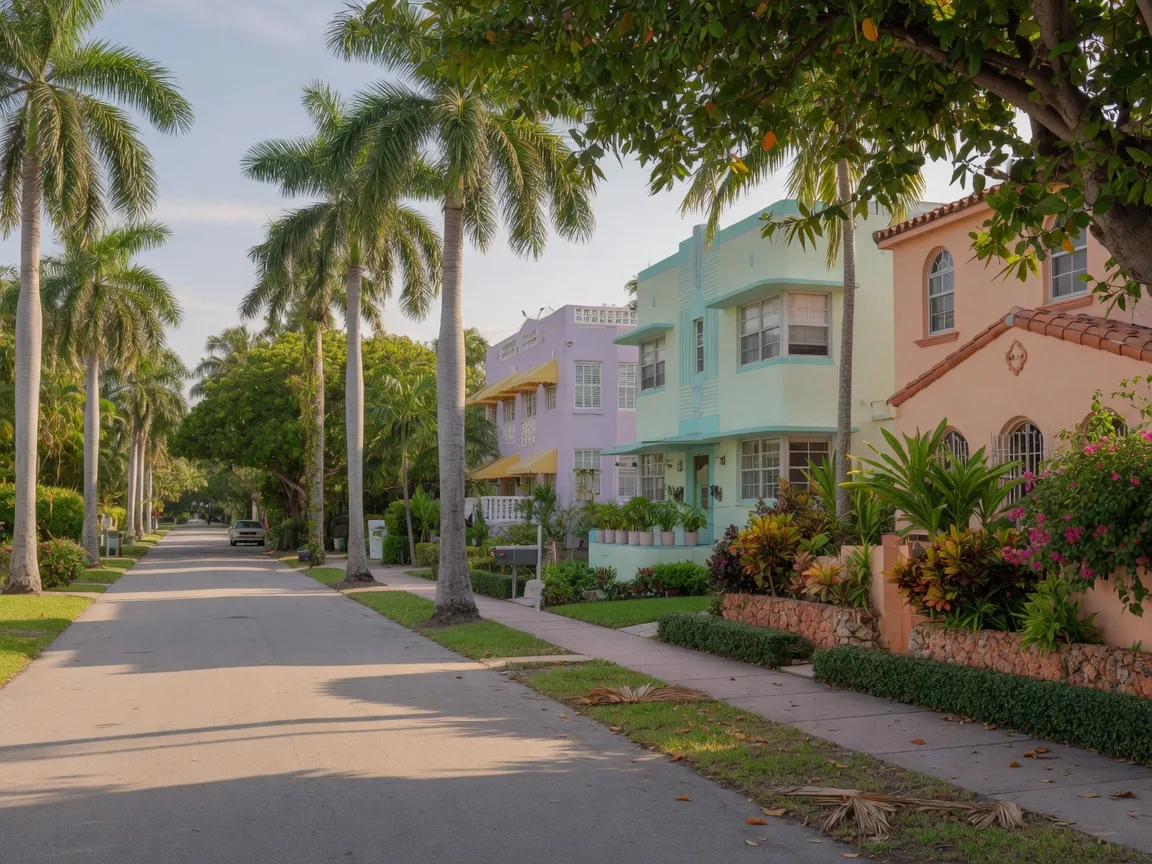
The everyday Miami
Palms, pastels, warm light
“The point of this section is not a fake-precise number, because your household
is different from the next. When we talk about your budget, I walk you through the
real line items for the actual homes and ZIP codes you are considering.”
Ruth Rivera · Your Fearless Real Estate Resource
Pros and cons
The honest pros, and the practical cons.
No place is right for everyone at every moment, and Miami is no exception. Here are the
real strengths, and the things that ask a little planning, framed the practical way I
frame them for my own clients.
What Miami does well
A global gateway city
Miami International Airport, PortMiami, the banking and fintech towers of Brickell, and a business culture that bridges the Americas. If international careers, trade, or travel are part of your life, few U.S. cities connect like Miami does.
Beach and bay everyday life
The ocean, the bay, the parks, and the warm season run year-round. Weekend plans involve water more often than not, and the city's design seems to follow.
A genuinely bilingual city
English and Spanish weave through daily life, business, and neighborhoods, in every accent of the Americas. As a bilingual agent, I love helping buyers relocating from Latin America or Spain find their footing here from the very first call.
Strong, diverse job engines
Finance and fintech, healthcare, aviation, logistics, construction, tech, and tourism all run deep in Dade. The county keeps drawing national and international companies, which keeps the market moving.
Distinct, walkable neighborhoods
Old Florida charm in the Grove, Mediterranean elegance in the Gables, street art in Wynwood, high-rise energy in Brickell: each neighborhood feels like its own city, which means most people find one that feels like home.
What to plan for
Housing costs above the national average
The price tag is real, and the planning is simple: we run the honest budget first, then match it to the right neighborhood and property type. Condos, townhomes, and the county's farther-out suburbs widen the range of what is possible.
Congestion on the main corridors
Traffic is part of the trade for living in a global city. The fix is strategic: choose a home near your job corridor, use the express lanes and toll roads when time matters, and let transit handle the downtown and Brickell trips.
Hurricane season
A fact of Florida life, managed well: we check flood zones, roof age, and wind-mitigation features on every home, and we get real insurance quotes before you commit. Most of the year, Miami's weather is among the best in the country.
Summer heat and humidity
Real, and manageable: efficient air conditioning, insulated windows, and tours planned for cooler mornings. We check AC age and efficiency on every visit, and the pool becomes part of your mental weather.
Insurance and taxes vary by address
Same home, different ZIP: because premiums and millage vary block to block, we get real quotes and tax estimates for the actual address before you make an offer, so the numbers never surprise you at closing.
A car still matters outside the walkable core
Brickell, downtown, Wynwood, and South Beach are walkable and well-served by the Metromover and Metrorail, but most of the county is still car-based. Choosing a home near the corridors you use keeps the daily drive short, and that is exactly what we plan together.
Relocator FAQ
Questions people ask before they move.
These are the questions relocators actually type into Google and AI tools when they are
weighing the move to Miami. Here are my direct answers, in my own voice, and every one of
them ends with the same open door.
Is Miami a good place to live?
For the right person, deeply so. Miami is an international gateway city where the beach lifestyle, a Latin American business hub, and some of the most distinct neighborhoods in Florida all meet in one county of about 2.8 million people (U.S. Census Bureau, 2025 estimate). Warm weather, no state income tax, a bilingual culture, and a job market with real engines draw newcomers from all over the world, and almost everyone I work with finds a version of Miami that feels like home. Tell me what you want out of a city, and I will tell you honestly whether Miami is it.
Is Miami affordable?
Honestly, housing is the expensive part: the Miami area runs roughly 20% above the national average overall, with housing 55% to 60% above it (RentCafe and PayScale, 2026). The balance is no state income tax, rents that vary widely by neighborhood, and a broad range of property types, from condos to suburban single-family homes. The sourced numbers are in the snapshot above, and I always build a personalized budget before anyone shops, so you know your real number.
What are the best neighborhoods in Miami?
There is no single best neighborhood, only the best fit for your commute, your budget, and the way you want to live. Brickell suits urban professionals, Coconut Grove and Coral Gables suit families who want character, Wynwood suits creatives, Kendall suits suburban family life, Doral suits the airport corridor, Miami Beach suits the beach set, and Aventura suits resort-style living. Tell me where you will work and how you want to live, and I will narrow it to the two or three areas worth touring first.
Do I need to speak Spanish to live in Miami?
Not at all. English works everywhere in Miami, and Spanish enriches daily life: signs, menus, business, and street life all mix both languages, which is part of what makes the city feel so international. As a bilingual agent, I can serve you in either language, and I love helping relocators from Latin America and Spain feel at home here from the very first conversation.
How bad is Miami traffic?
Peak traffic on the main corridors is genuinely heavy: the average one-way commute is about 31 minutes (Census ACS, 2024), greater Miami ranked second among U.S. metros for congestion in TomTom's 2025 index, and INRIX's 2024 scorecard put it sixth nationally. The good news is that it is also predictable and manageable: express toll lanes, the Metrorail and free Metromover downtown, and choosing a home near your job corridor all take the worst of it off your plate, and that is the plan I build with every client.
Is Miami safe?
Miami-Dade's crime trends have been moving in a clearly positive direction: violent crime dropped about 17% in the first four months of 2025 versus the same period in 2024 (Miami-Dade Sheriff's Office), and homicides fell 39% in early 2025 year over year (Axios, Major Cities Chiefs data). As in any large county, safety varies block by block, so I help buyers look at the specific neighborhood, the street, the building, and the community, not just the county line.
Can I live in Miami without a car?
In the walkable core, yes, comfortably: Brickell, downtown, and parts of Wynwood and South Beach are served by the Metrorail and the free Metromover, with Metrobus, Tri-Rail, and Brightline covering the wider region. Outside that core, most daily life is still car-based, so the practical answer depends entirely on where you live and where you need to be. I will always lay out the real transit options for the specific neighborhoods you are considering.
What is Miami's weather like?
Warm most of the year: hot, humid summers with frequent afternoon thunderstorms, since most rain falls May through October, and mild, drier winters that are part of why people move here. Miami averages about 62 inches of rain a year (NOAA-based climate data), and hurricane season runs June through November, which is why we check flood zones and wind features on every home.
How are the schools in Miami?
Miami-Dade County Public Schools is one of the largest districts in the nation: about 530 schools and roughly 313,000 to 333,000 students depending on the count and the date (NCES and district reports, 2025-26), which means real depth of programs, magnet options, and school choice. The honest rule is the one I repeat everywhere: school assignments are address-specific and can change, so buyers verify the exact address with the district before making an offer, and I help with that every step of the way.
Should I rent or buy in Miami?
The honest answer is that it depends on your timeline. If you expect to be in the area for fewer than a couple of years, renting keeps your options open, and Miami has strong rental inventory from downtown towers to suburban communities. If you are putting down roots, buying builds equity and locks in your housing cost, and today's market, with sales rising and supply more balanced, gives prepared buyers real negotiating room. Let's run the honest numbers for your plan together.
Equal professional service
A fair chance at home in Miami, for everyone.
Ruth provides equal professional service to all clients, regardless of race, color,
religion, sex, disability, familial status, or national origin, and follows the
REALTOR® Code of Ethics and the Fair Housing Act. Every relocator gets the same
care, the same honesty, and the same protection, in English or Spanish.
Ready to find your Miami home?
Whether you are moving next month or exploring for next year, I would love to be your guide.
Start by searching homes through my Coldwell Banker page, or send me a note and tell me
about your move. I answer personally, in English or Spanish, with no jargon and no
obligation.